
Building students’ capacity to understand the difference between active and passive voice
by Brian Dare
The passive voice remains an important arrow in the rhetorical quiver.
This somewhat cryptic quote is from an article in The New York Times written by Constance Hale and entitled ‘The pleasure and perils of the passive’. In this incisive article, which explores the pros and cons of the passive voice, Hale points out ‘the bad rap’ the use of the passive voice evokes.
You may well remember a catchy song from a CD doing the educational rounds in the 80s which contained the lines ‘when you have a choice, when you have a choice, put it in the active voice’. Like a lot of ‘rules’ about the ‘proper’ use language, however, this view lacks a more complex and nuanced understanding of the functional uses of the active and passive voice.
In contrast to the belief that it is better to avoid the passive voice, those of us taking a functional perspective would argue that it is far more useful to understand how the passive voice is used for a range of purposes across a range of contexts, and why. The bad press directed towards the passive voice is caused by the passive voice being used to avoid agency, and hence responsibility, for a particular action. For example, in the following clauses, the ‘doers’ of the actions of ‘reducing’, ‘making’ and ‘pilloring’ have been removed, so we don’t know who is responsible for these actions.
The subsidy has been reduced.
Mistakes were made.
They were pilloried for their views.
But, the passive voice (including my own use of ‘have been removed’ in the previous sentence) provides certain useful affordances for speakers and writers.
In Science for example, human actors are often absent because scientists are more concerned with the processes of science, especially when investigating and experimenting. This means that learning about the passive voice supports students’ comprehending and composing a whole range of texts they meet in Science (Ping Alvin L 2014)¹. Other disciplines also draw significantly on the passive voice (Moreb 2016)², particularly as students move up to the higher levels of schooling.
Given that research is telling us that native and non-native speakers of English all experience some degree of difficulty with the passive voice (Celce-Murcia et al., 2015), I will explore ways we can open up this territory to our students.
Making it explicit
Let’s start with a context where students are doing a science investigation as part of their learning about ‘How light works’. The students, aged around 10 to 11 years old, are observing the length of a shadow cast by an object in relation to the distance of the light source from the object.
What typically happens, following such an investigation, is that students are required to write a laboratory report. A laboratory report has very similar staging to the procedure stage of the science investigation, that is, the stage where students are instructed ‘what to do’. In the laboratory report, however, this stage becomes instead a recount of ‘what we did’. For this reason, a different set of language resources come into play.
In describing the following set of classroom activities, we will assume that these students have some familiarity with identifying processes, participants and circumstances within clauses and sentences, as discussed in my previous blog: Introducing students to the functional groupings: processes, participants and circumstances.
Focusing on the Procedure (or Method) stage of the science investigation
The text below has been formatted into separate clauses. This enables the teacher and students to complete a joint transitivity analysis of these clauses, as shown in Figure 1.
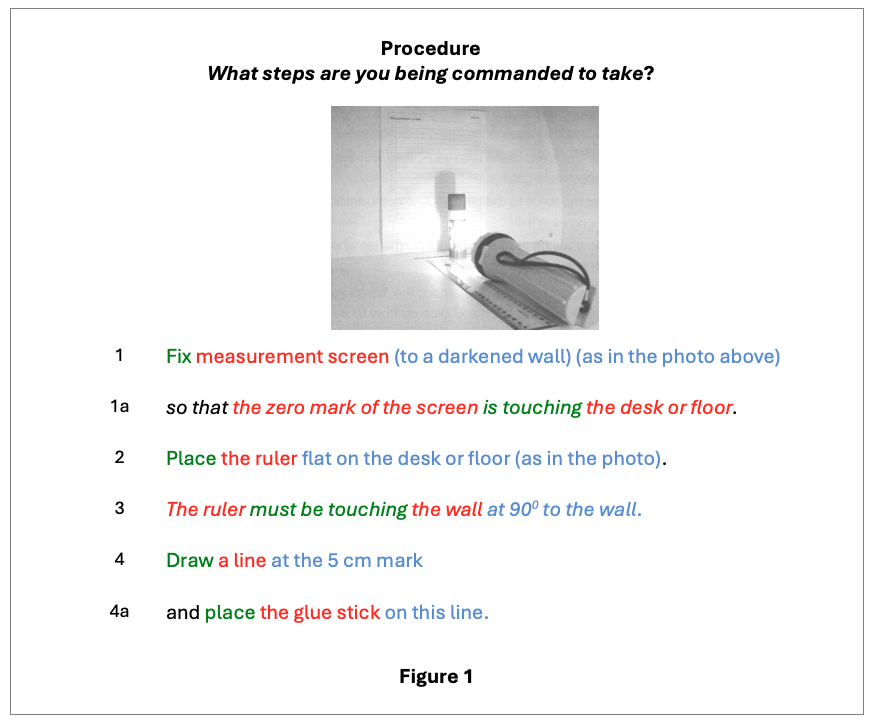
Undertaking such an analysis with the students would be beneficial for a number of reasons.
In the first instance, it would give the students a chance to consolidate their understandings of the functional groupings of any clause.
Secondly, such a close analysis provides an ideal vehicle for comprehending all the meanings inherent in the method section, ensuring much greater success for students actually doing the investigation.
Importantly, it will provide a springboard for understanding the passive voice, a resource they will need as they compose the procedural recounts of their laboratory reports.
Focusing on the procedural recount stage of the laboratory report
Once they have completed the investigation and recorded their results, the students compose the laboratory report. A major challenge for students in composing this report is the procedural recount section of the report where they ‘convert’ the original method section, as seen in Figure 1 above, into a recount of what they did. Typically, students are required to write up the method stage of the investigation in either the active voice using past tense (Example 1) or in the passive voice in the past tense (Example 2).
Example 1 (active): We fixed the measurement screen to a darkened wall.
Example 2 (passive): The measurement screen was fixed to a darkened wall.
Example 1 is in the active voice because the subject ‘We’ is the doer of the action ‘fixed’. Example 2 is in the passive voice because the subject of this sentence ‘The measurement screen’ is not the doer of the action ‘was fixed’.
My experience in working with science teachers is that they inevitably prefer the passive voice construction shown in the second example even if they cannot name it.
Unpacking the passive voice
So rather than just telling the students to use the passive voice and giving them a few examples, it would be far more illuminating for the students to see what happens grammatically as we shift from the procedure in the method section of the science investigation to a recount in the active voice in the laboratory report, and, finally, to the recount in the passive voice, where we can either still see the ‘we’ or ‘I’, or where the ‘we’ or ‘I’ are not needed.
We can illustrate this shift by considering each clause in Figure 1 and writing a new version in the active voice, using ‘We’ or ‘I’ as appropriate, and undertaking a transitivity analysis of this new version.
Without analysis:
We fixed the measurement screen to a darkened wall so that the zero mark of the screen was touching the desk.
In clauses and analysed:
We fixed the measurement screen to a darkened wall
so that the zero mark of the screen was touching the desk.
As noted in my previous blog, we can ask a set of questions to identify these groupings but we now have to ask some slightly different questions from the analysis of the Method (procedure) section in the science investigation in order to identify the participants ‘We’ and ‘the zero mark of the screen’ in the laboratory report (Who ‘fixed’ the measurement screen to a darkened wall? and What ‘was touching’ the desk?).
We can also draw students’ attention to the change in tense from ‘Fix’ to ‘fixed’ and ‘is touching’ to ‘was touching’. Note that there is no change in the second clause apart from the tense.
To make the shifts in the grammar explicit, we would now ask students to focus on the first clause and write each grouping on red, green and blue paper strips as per the analysis. Once they have done this, they could lay out the full clause as it is written and then identify the ‘Doer’ of the action which is ‘We’ and the ‘Done to’³, which in this case is ‘the measurement screen’. This is illustrated below.
Active voice

We would now get the students to bring the ‘Done to’, ‘the measurement screen’ strip, to the front of the clause, resulting in the un-grammatical sentence below.
Passive voice (initial clause)

We would now discuss with the students the various changes needed to make the sentence grammatically ‘correct’. The students could mark on the cards the various changes needed. One of the obvious changes is the verb ‘fixed’ needs the addition of the finite ‘was’⁴.
Once this is attended to, we would focus on the ‘We’ and have the students cross out the ‘We’ and write in ‘by us’. We would then change ‘the’ to ‘The’, reflecting its initial position in the sentence.

We would then remove the ‘by us’ strip altogether, thus removing the ‘Doer’, leaving us with the recast version as per below.
Recast clause using the passive voice

If we now have the students writing out the full sentence, we would have something like this.
The measurement screen was fixed to a darkened wall so that the zero mark of the screen was touching the desk.
It is also worth drawing students’ attention to the second clause, which remains in the active voice. If we were to change that also to passive voice, we would have a gratuitously unnecessary ‘so that the desk was being touched by the zero mark of the screen’. This is grammatically correct but also a rather unnecessary meaning here, and it is worth discussing with students the reasons why this remains unchanged in terms of voice.
Each of the clauses would be taken in turn to consolidate student understanding.
Just to reiterate, I will take the next clause and repeat the process as a model for the remaining clauses.
Step 1
Write out the clause ‘We placed the ruler flat on the desk as in the photo’ and carry out a transitivity analysis. The students would then write each grouping on red, green and blue paper strips as per the analysis, identifying the ‘Doer’ and ‘Done to’ as shown.

Step 2
Switch the ‘Doer’ and the ‘Done to’ and discuss with the students what changes need to be made:

Step 3
Make the changes to the “Doer’ and ‘Done to’ to make the sentence ‘correct’.

Step 4
Remove the ‘Doer’ and any other superfluous information.

Step 5
Add this text to the previous sentences of the procedural recount section and continue the process with the remaining clauses.
In summary
If we accept the view that ‘The passive voice remains an important arrow in the rhetorical quiver’, in accordance with what the research is telling us about the prominence of the passive voice, then it makes sense to build students’ capacity to understand how this important linguistic resource works.
As always, it does take a bit of linguistic work and some explicit teaching to make these underlying patterns in the active and passive voice visible; but, in the end, slowing down and examining this important language resource more forensically in the ways suggested above will be extremely helpful for students and I believe will, somewhat paradoxically, speed up their learning.
[1] See Ping, A. L. (2014), whose research showed that over 30% of all clauses were in the passive voice and 29% of those were found in the methodology section.
[2] See Moreb, B. (2016), offers a very good perspective on the frequency of passive voice in a corpus of first year university textbooks.
[3] These terms and the colour coding were originally used by Ruth French and her students at Haberfield Primary School (see French 2013).
[4] This is also known as the ‘auxiliary’ part of the verb and expresses tense and is either singular or plural depending on the number in the subject position.
References
Celce-Murcia, M., Larsen-Freeman, D. & Williams, H. A. (2015). The grammar book: Form, meaning, and use for English language teachers (3rd ed.). National Geographic Learning/Cengage Learning.
French, R. (2013). Teaching and Learning Functional Grammar in Junior Primary Classrooms, PhD thesis. University of New England, Armidale, NSW.
Halliday, M. A. K. & Matthiessen, C. M. I. M. (2004). An introduction to functional grammar. (3rd ed) London, Hodder Education.
Leong, P. A. (2014). The passive voice in scientific writing: The current norm in science journals. Journal of Science Communication, 13(1), A03. https://doi.org/10.22323/2.13010203
Moreb, B. (2016). The frequency of passive voice in freshman academic books. Master's thesis. University of Central Florida. Electronic Theses and Dissertations, 5429. Available at: https://stars.library.ucf.edu/etd/5429
About the author
Brian Dare is a director of Lexis Education. He is the co-author of a number of professional development courses underpinned by an explicit language-based pedagogy.