
S.A.O.D. (Severe Acronym Overload Disorder)
by Beverly Derewianka
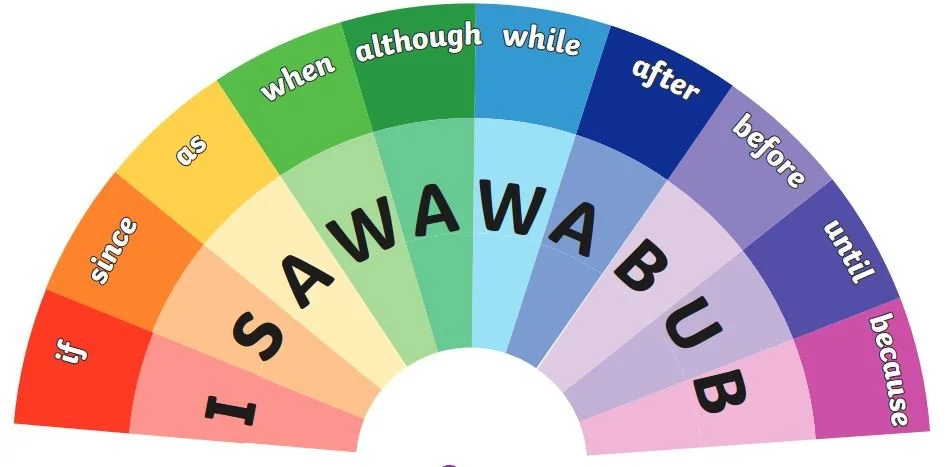
A focus on ‘explicit teaching’ has produced a slew of acronyms relating to language study, such as these found on Twinkl and Teachers Pay Teachers (TPT):
PNDCTQ (Ponies Never Doubt Cats That Quit) to help remember the nominal group functions (Pointer, Numerative, Describer, Classifier, Thing, Qualifier).
I SAW A WABUB for subordinating conjunctions (If, Since, As, When, Although, While, After, Before, Until, Because).
And if that doesn’t work, try A WHITE BUS (A: As, after, although; W: When, whenever, where, wherever, while; H: How, however; I: If; T: Than, though; E: Even if, even though; B: Before, because; U: Unless, until; S: So that, since.)
IQTVE
And then there are the sentence-level prompts. In a recent newspaper article there was a glowing tribute to a school that had remarkably increased its HSC ranking, moving from 33rd to 2nd in the final English exam by using the formula ‘IQTVE’. The deputy principal, and HSC English marker, said the cohort’s perfect-scoring essays shared a common structure: “idea, quote, technique, verb and evaluate”. She explained that most important part of the technique is the “V” – the verb. “When you’re looking for a really quality piece of writing, particularly in English, you’re looking for evaluation … And what the verb does is it forces the students to then actually have to do something with the information because otherwise they can just become quite recount or descriptive,” she said.
Bubble Theory (TDT)
A similar phenomenon is Bubble Theory (also known as the Seldon Method and TDT – ‘This does that’), invented by a NSW Department of Education secondary school and promoted by the Department on its website as a way of teaching complex sentences across the school and in all subjects. It again claims positive growth in the HSC results. The strategy employs the easy-to-build sentence structure of: This..., does that..., doing that..., and doing that (using ‘analytic verbs’). The example is provided of:
‘THIS’ (‘evidence from the text: 'a stingy ray of sunlight struggles feebly down between the houses tall.')
‘DOES’ (evokes)
‘THAT’ (the dim dark misery of the city.)
The pattern can then be extended by adding one or two ‘ing’ verbs: ‘This..., does that..., doing that..., and doing that’, as in
THIS (‘a stingy ray of sunlight struggles feebly down between the houses tall’)
DOES (evokes)
THAT (the dim dark misery of the city,)
DOING THAT (suggesting that city life is congested and unhealthy,)
AND DOING THAT (and creating a juxtaposition to the open, light, airy beauty of the outback that was described earlier in the poem).
PETAL
Moving to the paragraph level, we find PETAL:
Point (topic sentence or main idea of the paragraph that directly answers the essay question);
Evidence (relevant examples, facts, or textual quotes from the source material that support the main point);
Technique (identification of literary devices (e.g., imagery, metaphor, symbolism) used by the author in the evidence);
Analysis (an explanation of how the evidence and technique work together to create meaning and support the point, exploring deeper implications);
and Link (a concluding sentence that ties the analysis back to the paragraph's main point and the overall essay thesis or argument, ensuring coherence).
These elements of a literary response paragraph might bear some resemblance to the phases within stages of genre theory. The difference is that phases are seen as flexible, often optional choices that are not confined to a strict sequence.
While the first set of acronyms are simply (absurd) mnemonics, the latter provide strategies that appear to have results. While our first instinct might be to despair or denigrate, we might take a moment to reflect on why they are so appealing – even to teachers who eschew genre theory on the grounds that it is too formulaic.
If you were a secondary English student, for example, would you prefer to use Bubble Theory or SFL? In relation to the Bubble Theory example above:
‘A stingy ray of sunlight struggles feebly down between the houses tall’
evokes
the dim dark misery of the city,
suggesting that city life is congested and unhealthy,
and creating a juxtaposition to the open, light, airy beauty of the outback that was described earlier in the poem.
a strict SFL approach would have involved applying knowledge of a complex sentence that includes
an independent material clause consisting of an embedded clause realising the Actor,
linked by an abstract material Process
to an extended nominal group realising the Goal (including a nominalisation),
followed by a dependent non-finite verbal clause complex
and a dependent non-finite material (causal) clause
(both of which, in this case, are non-restrictive rather than restrictive – though noting that the embedded clause in the second one is restrictive)?
Not that we would endorse such an approach, but would even our recontextualization of such a description garner the same acceptance by teachers and students as the strategies above? While we would argue that knowledge about language as a meaning-making system is more generative than the use of reductive short cuts, might we need to consider the realities of time-poor teachers who feel overwhelmed by the extravagance of SFL? While our SFL professional learning programmes have the benefit of being able to introduce the theory behind the model, the regular classroom teacher doesn’t have this luxury and is tempted to resort to quick fixes.
One of our CLLERP projects (now there’s an acronym!) is focusing on identifying models of language (and associated metalanguage) underpinning a range of policy documents and support materials. Perhaps we then need to go further and identify which grammatical resources have the biggest impact on student outcomes and focus on ways of making these more accessible and useful for teachers and students – without resorting to simplistic techniques.
References
Bubble Theory: NSW DoE advice to teachers
The five-letter formula that saw this school’s HSC English marks soar, Emily Kowal, Nigel Gladstone and Siena Fagan, December 20, 2025
PETAL scaffold on Benang: NSW DoE
About the author
Dr Beverly Derewianka is an Emeritus Professor (Language and Literacy Education) and Professiorial Fellow at the University of Wollongong, NSW.