
Considering some grammar with the opening lines of ‘Twelfth Night’
Author: Gary Collins
This blog entry has been distilled from an article published in 2025 in Words’Worth, the journal of the English Teachers Association of Queensland (ETAQ). It was developed from a workshop presented in 2025 at the joint national conference in Hobart of AATE (the Australian Association for the Teaching of English) and ALEA (the Australian Literacy Educators’ Association) and in Brisbane at the ETAQ Annual State Conference.
Different views of grammar
For many people, both within the teaching profession and in the general public, the word grammar is primarily connected with notions of correctness, adherence to rules, and the rectification of faulty expression. While an element of this is inescapable in the work of classroom teachers, it is often more productive to think about grammar as a system of choice. Different selections from the potential that the language makes available will construct different meanings. Texts can be relatively free of conventional grammatical errors but still not particularly effective since the grammar patterns deployed are not fully appropriate for the genre and purpose, or the intended audience.
In summary, grammar can be thought about as a box of tools rather than just as a set of rules. (Working on the principle that imitation is the sincerest form of flattery, I borrowed the words for that comparison from a book called The Glamour of Grammar by an American writer named Roy Clark. I am reasonably confident that Mr Clark is not acquainted with functional grammar, but he certainly has the right general idea.)
A lesson in grammar and literature
The focus literary text is the first three lines of Shakespeare’s play Twelfth Night. Duke Orsino of Illyria is addressing one of his servants, a court musician.
If music be the food of love, play on;
Give me excess of it, that, surfeiting,
The appetite may sicken, and so die.
Groups and phrases
To build the knowledge students need to explore the grammar of the focus text, at the start of the lesson, students could be asked to identify ‘chunks of meaning’ in the following sentence:
In this lesson we will consider some of the grammar patterns in the opening lines of Shakespeare’s play ‘Twelfth Night’.
This sentence consists of 20 words but, in the construction of meaning, they don’t function as 20 separate items. Instead, from a grammatical point of view, these lines consist of significantly fewer ‘chunks of meaning’. Before students can recognise these chunks of meaning, they need to build knowledge about grammar, including knowledge about chunks of meaning (more technically, groups and phrases) and about the grammar rank scale.
How many chunks of meaning are there in this sentence?
The ‘chunks of meaning’ in the sentence can be represented in the following 3-row table:
Row 1: wordings (‘chunks’)
Row 2: functional labels to reveal the work of each ‘chunk’
Row 3: the grammatical structures that are doing the work
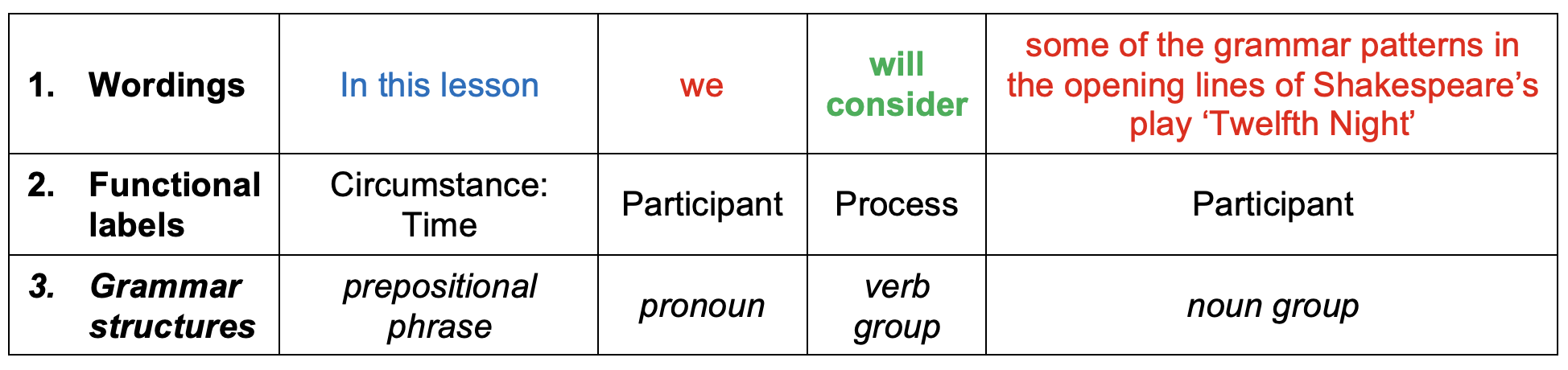
The sentence contains a single verb group (the Process), will consider. This means that it contains just a single clause.
There are two Participants in the clause. The second Participant is represented by a noun group, a reasonably complex one.
The prepositional phrase (beginning with the preposition ‘in’) expressing the Circumstance of time at the start of the clause contains a much simpler noun group, this lesson.
Rank scale
Groups and phrases are located between clauses and words on a scale which ranks elements of language in a hierarchy.
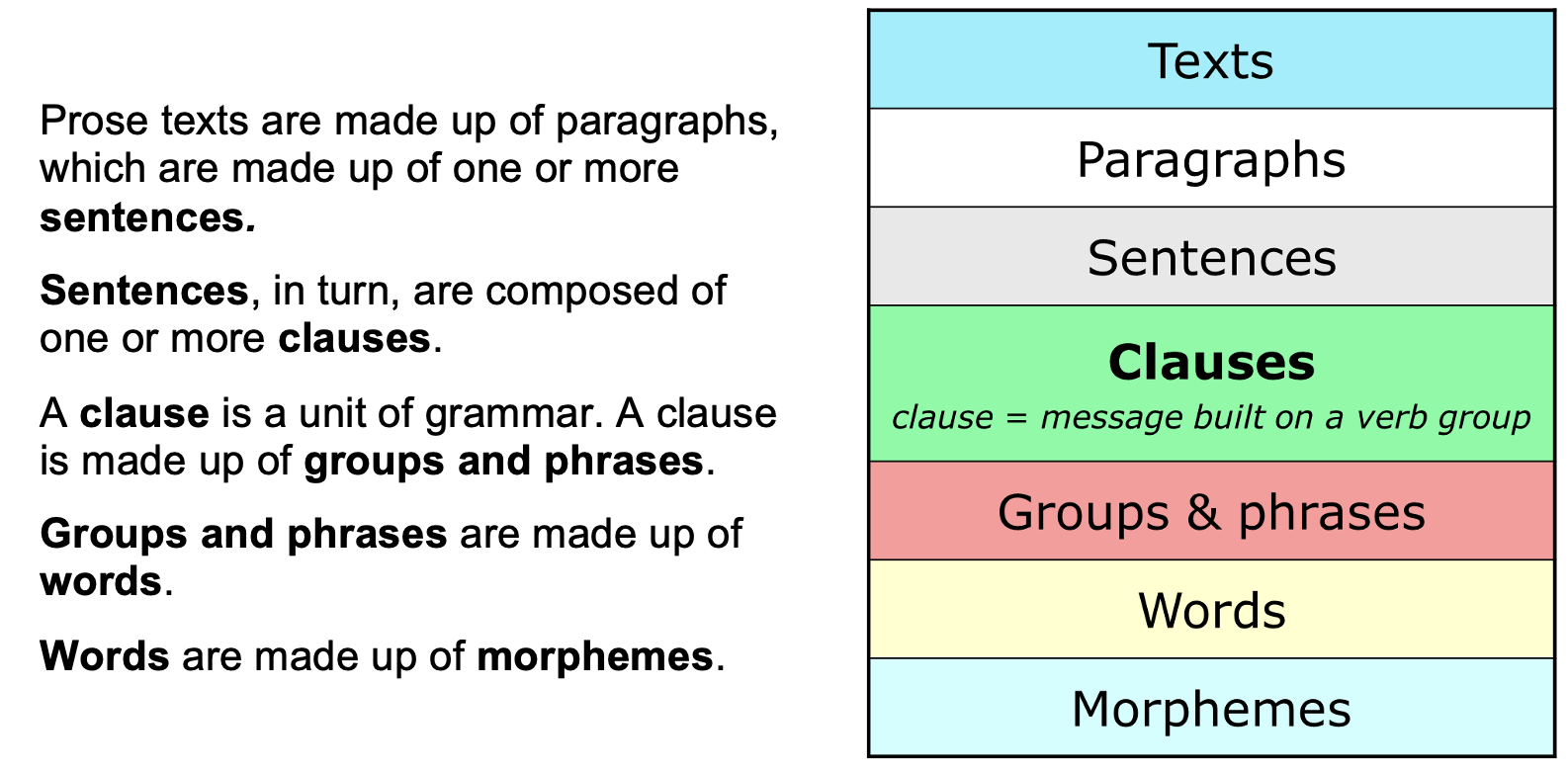
The grammar rank scale is the hierarchical arrangement of linguistic structures in which groups fit between clauses above and words below.
Clauses consist of one or more groups and phrases (but if there is only one group or phrase, it has to be a verb group).
Groups are made up of one or more words.
Words are made up of one or more morphemes.
Noun groups
In functional grammar, groups are extensions of words: noun groups, verb groups, adjective groups etc. To the initial irritation of some, there can also be groups made up of one word, so a single noun can be referred to as a noun group at the group level.
Noun groups (sometimes called noun phrases) are mentioned several times in earlier versions of the Australian Curriculum: English but with no explanation of their structure. In the current version 9, however, a Year 2 Language Strand content description (AC9E2LA07) makes a start on explaining noun groups:
understand that in sentences nouns may be extended into noun groups using articles and adjectives, and verbs may be expressed as verb groups
The main noun (the head word in a noun group) has the potential to be preceded by four different kinds of modifying elements and then additional, related information can also be added after the main noun.
We have seen above that AC9E2LA07 provides the first useful grammatical explanation of noun group structure. (Note the noun group highlighted at the end of this sentence.)
The elements of the highlighted noun group have been fitted into the table below. And yes, I did deliberately compose it to have an element in each of the potential slots.

Remember that at the start of the proposed lesson, students are to be asked to identify ‘chunks of meaning’ (groups and phrases) in this sentence.

The structures of noun groups used in the sentence are shown in the table below.
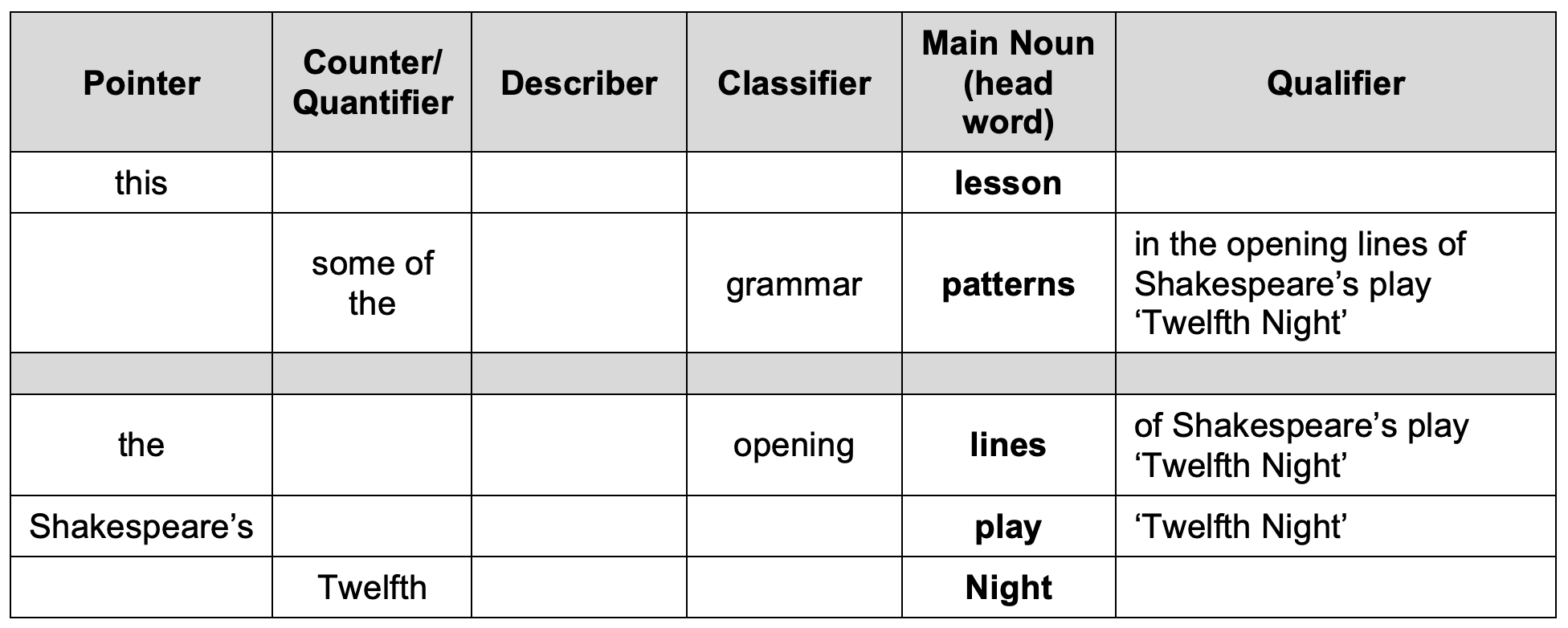
As already noted, the noun group within the opening Circumstance is this lesson. This noun group is quite simple with just a Pointer and the Main Noun.
By contrast, the noun group representing the second Participant in the clause has Counter/Quantifier (some of the) and Classifier (grammar) elements preceding the Main Noun (patterns - the head word of the group) which is followed by a Qualifier with more information. This Qualifier is expressed or realised by a prepositional phrase (starting with the preposition in) and, in turn, the noun group within this phrase has another prepositional phrase (starting as the preposition of) as its Qualifier. The other noun groups progressively ‘nested’ within the Qualifier of the noun group based on the plural noun patterns are below the shaded row in the table.
This ‘nesting’ of smaller chunks of meaning within larger ones can make some texts difficult to unpack. I suggest that it is reasonable to think that students will be more readily able to construct or unpack appropriate meanings with such texts if they are explicitly aware of the structure at work.
The focus text
After the preliminary activity described above, a lesson could then proceed to consider the noun groups in the focus text (formatted as drama script).
If music be the food of love, play on;
Give me excess of it, that, surfeiting,
The appetite may sicken, and so die.
Has the Bard committed a grammatical error?
Before turning to the main focus of the noun groups deployed in this text, a little time could be spent considering its first clause and the word classes (parts of speech) of the words that comprise it.
If (subordinating conjunction) music (noun) be (verb) the (article) food (noun) of (preposition) love (noun)
What this shows is that Shakespeare has begun the opening sentence of the play with a conjunction.
There was a time, not all that long ago, when school students routinely had it drummed into them, and many in the general community believed, that it was a grammatical error to begin a sentence with a conjunction. The ‘Grammar Police’ who disapproved of this supposed error usually had mainly in mind the coordinating conjunctions and and but, though the so-called ‘rule’ just referred to ‘a conjunction’.
There is, of course, nothing wrong with this construction at all. But a long series of sentences all beginning with the word and would certainly become tiresome.
In the current version of the Australian Curriculum: English, a Year 10 content description (AC9E10LA05) reads ‘analyse and evaluate the effectiveness of particular sentence structures to express and craft ideas’, and it has this elaboration:
recognising that a sentence can begin with a coordinating conjunction for stylistic effect; for example, “And she went on planning how she would manage it.”
Now on to noun groups
Below are Shakespeare’s lines (formatted as prose) and with the head words of most of the noun groups shaded:
If music be the food of love, play on; give me excess of it, that, surfeiting, the appetite may sicken, and so die.
The structure of the noun groups built around the shaded words is shown in the following table.
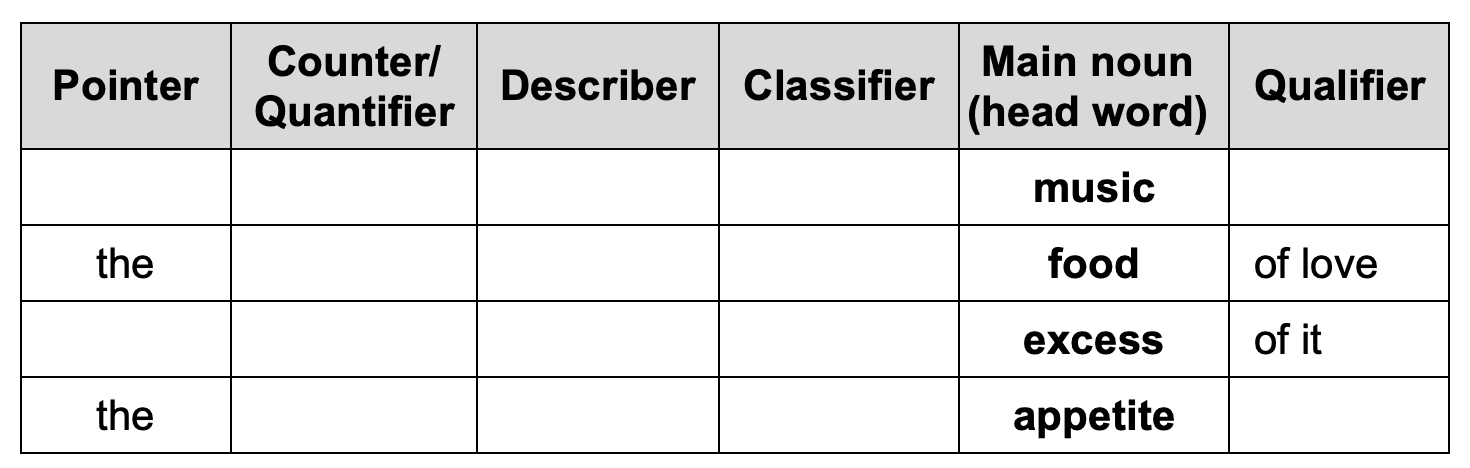
It can be readily seen that these are simple noun groups – the first is just the single word music - with little of the potential of the structure employed.
Adding more detail
A follow-up activity could be to have students add more details. Some possibilities are shown in the table below with the new elements being shown in italics. Of course, this is not meant to suggest that these more complex noun groups are necessarily more effective. It is, rather, just to demonstrate the potential of the structure.
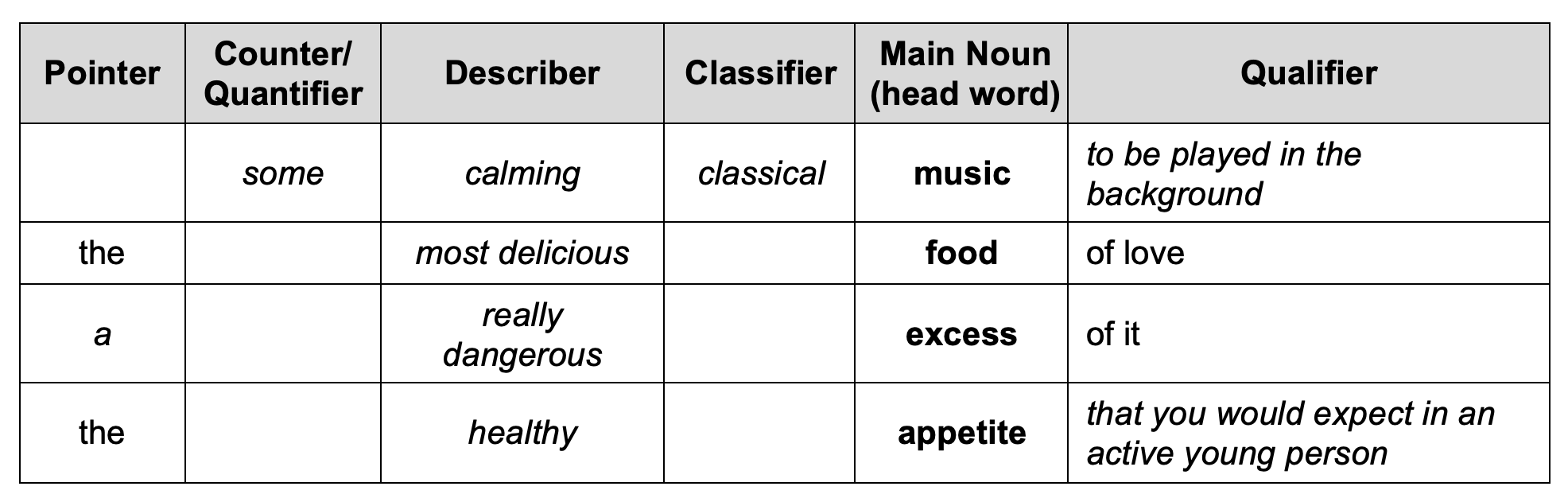
I suggest that this activity of adding, with explicit knowledge of the relevant structure, more details to noun groups selected from a particular text is a useful classroom exercise.
Conclusion
The focus here has just been on noun groups. Further teaching and learning could relate to the component clauses in Shakespeare’s lines and the sorts of messages that they express.
References
ACARA F-10 Australian Curriculum: English at https://v9.australiancurriculum.edu.au/f-10
Clark, R. (2011) The Glamour of Grammar: A Guide to the Magic and Mystery of Practical English, New York, Little, Brown & Company
About the author
Garry Collins taught secondary English for 35 years, mainly at Gladstone and Ferny Grove State High Schools in Queensland, but also on year-long exchanges in Oregon in the US and Ontario in Canada. He is a former President of both ETAQ and AATE. After retiring from full-time teaching, he was a part-time teacher educator for 8 ½ years, first at the Australian Catholic University and then at The University of Queensland. While still working at Ferny Grove High, he had also worked part-time at QUT and Griffith University teaching introductory courses on functional grammar. He is currently enjoying full retirement but continues to serve on the ETAQ Management Committee and regularly presents workshops at PD events.